

A smooth landing for your GRACE journey
Moving to another country is exciting, but it can also feel overwhelming. This page helps you prepare with confidence for your first semester in the GRACE programme. Whether you’re coming from across Europe or around the world — we’ve got you covered.
Here’s what you’ll find on this page:
- Arrival checklist
- Visa and residence permit support
- Health insurance and medical access
- First steps for housing and transport
Arrival Checklist
Make sure these steps are completed before travelling to Austria for your first semester.
For all students:
Passport or valid EU ID
Residence permit or visa application initiated (if applicable) with the support of the St. Pölten International Office.
Final university diploma(s) (original + certified English translation)
Transcript of records
Admission documents (e.g. GRACE acceptance letter)
Proof of health insurance
Personal medication and prescriptions
Emergency contact list
A few printed passport photos
Organised accommodation
Non-EU citizens:
- Residence permit or entry visa for Austria (depending on your citizenship – see section below)
- Proof of finances
- Birth certificate (translated)
You’ll receive support from our team during the visa process. See contact info below.
Recommended Reading: Residence Guide for Austria
For official and up to date information about residence permits, visa requirements, and financial documentation, please consult the official guidance provided by Austrian authorities:
Health Insurance
As a GRACE student, you are required to have valid health insurance during your stay in Europe. To make things easier, we’ve arranged a comprehensive Aon Student Insurance package that covers you throughout all four semesters of the programme — no matter which country you’re in.
What’s included in the Aon Student Insurance?
Medical coverage for both general doctor visits and hospital treatment
Emergency assistance, including repatriation and 24/7 multilingual support
Liability insurance, protecting you in case of personal or material damage
Coverage for personal belongings, with optional luggage protection
Easy claims process via a user-friendly online portal
This insurance gives you peace of mind so you can fully focus on your studies, projects, and travels.
🇦🇹 Additional option: Austrian Public Health Insurance (ÖGK)
If you’re staying in Austria for an extended period, you may also register for public health insurance (ÖGK) for around €70 per month. This is optional, but highly recommended for students who want easier access to local services.
With ÖGK, you’ll receive an e-card, which allows you to:
Visit contracted family and specialist doctors
Receive treatment in hospitals without paying upfront
Avoid unexpected out-of-pocket costs
You’ll receive guidance from the St. Pölten international office if you wish to register with ÖGK.
Housing in St. Pölten
For your first semester, we strongly recommend living in St. Pölten within walking distance of the university. The International Office at St. Pölten University of Applied Sciences can assist students in applying for accommodation in nearby student residences.
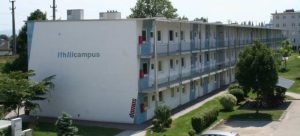
There are three student homes near the campus. St. Pölten UAS has reserved a number of rooms in:
- Campus Domus
- Wihast
- Campus Villa
If you wish to stay in one of these dorms, you must:
- Fill in the housing application form*
- Tick your preferred dormitory
- Submit the form before the deadline for international students
* You’ll receive this form after your admission. Early application is recommended as places are limited.
For more details, visit: Accommodation for International Students – St. Pölten UAS
If you have questions or need help securing housing, the international office in St. Pölten is happy to support you.

Spaces are limited. Early communication is strongly advised.
Visa & Residence Permit

To start your studies in GRACE, students must ensure they meet the visa and residence requirements for Austria.
For EU/EEA citizens
You do not need a visa to enter Austria. However, you may need to register your stay with local authorities if you remain in Austria for more than three months.
For non EU/EEA citizens
Students normally apply for a residence permit for study purposes in Austria. In many cases, you must first obtain a visa type D to enter Austria and then collect your residence permit after arrival.
The International Office at St. Pölten University of Applied Sciences will guide students through this process.
You will typically need to submit:
- A valid passport
- Your GRACE admission letter
- A birth certificate (with certified translation)
- Proof of finances
- Health insurance documents
- Passport photos and biometric data
Once approved, you’ll receive an entry visa that allows you to pick up your residence permit in person after arrival.
For full details, check: OeAD – Entry and Residence
Optional: On Arrival Tasks
Once you arrive in Austria, there are several practical and administrative steps you may wish to complete to make your daily life easier.
➤ Open a local bank account
We strongly recommend opening a bank account in Austria or another EU country within the SEPA area.
Please note: Scholarship holders are required to open a SEPA bank account to receive their scholarship payments.
You’ll receive support and recommendations from the international office in St. Pölten if needed.
➤ Register with a local doctor and dentist
Even if you’re in good health, it’s smart to register with a general practitioner (GP) soon after arrival, so you’re prepared if you ever need medical care.
➤ Get a SIM card or mobile data plan
Austria has several affordable mobile providers offering prepaid and contract plans. A local number is often helpful for housing, appointments, and travel apps.
Questions? We’re Here to Help
St. Pölten International Office
📍 Room B.2.38, Building B
📞 +43 2742 313 228 355 / 387
Contact us for help with visa questions, arrival planning, or student housing reservations.
Explore more support
Each GRACE partner university offers a wide range of student services beyond what’s listed here. Visit their websites to see the full details of academic, wellbeing, and community support:
